
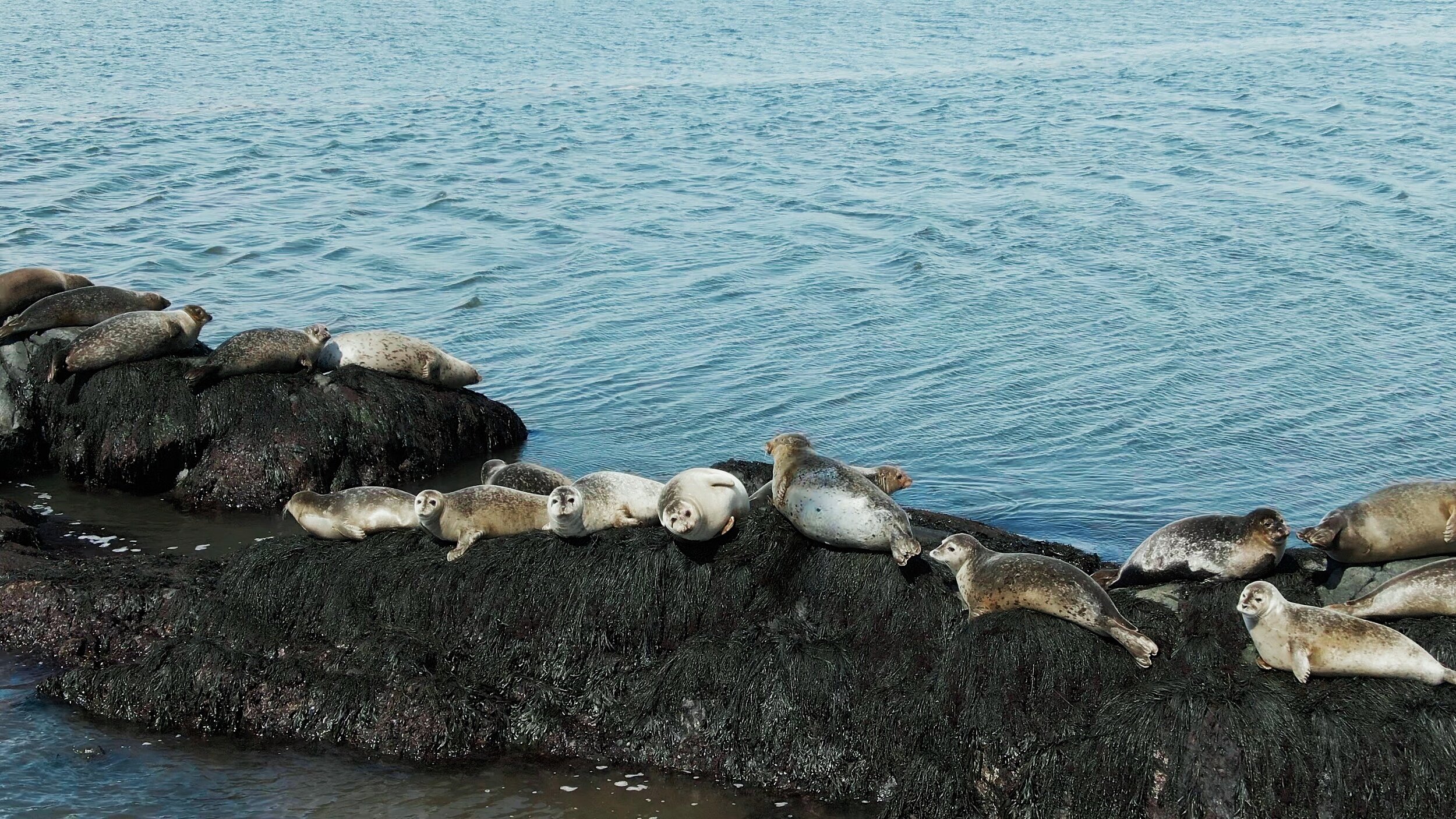
Seals in the Greater Saint John Area
The Harbour Seal (Phoca vitulina) population in Atlantic Canada is estimated to be 25,000, and the Grey Seal (Halichoerus grypus) population is estimated to be 424,300. Despite the presence of the seals in our Atlantic waters, little is known about their behaviour, food habits, and distribution.
Since 2018, ACAPSJ has been monitoring the populations of Harbour and Grey Seals in the Saint John Greater Harbour Area and in the Musquash Estuary Marine Protected Area (MPA). We use a combination of shore-based spotting with telescopes, shipboard surveys, and citizen reporting to count seals and document their swimming and haul-out behaviours. We have also collected samples of their scat to investigate their eating habits.
Throughout our projects, we encourage public participation! ACAPSJ uses citizen-reported seal sightings through email submissions and online surveys to gather a wider range of data – find out how you can submit a seal sighting here!
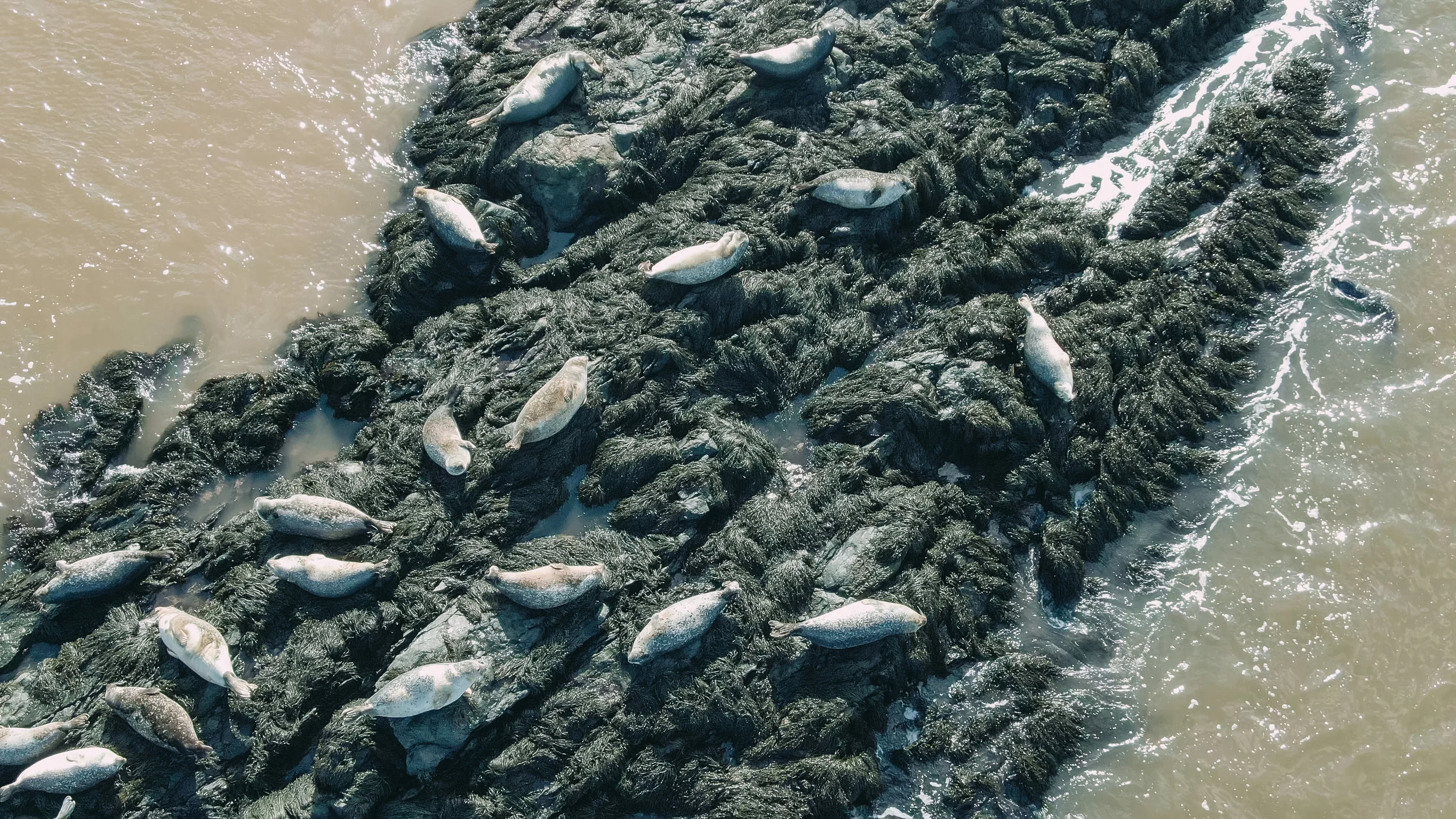
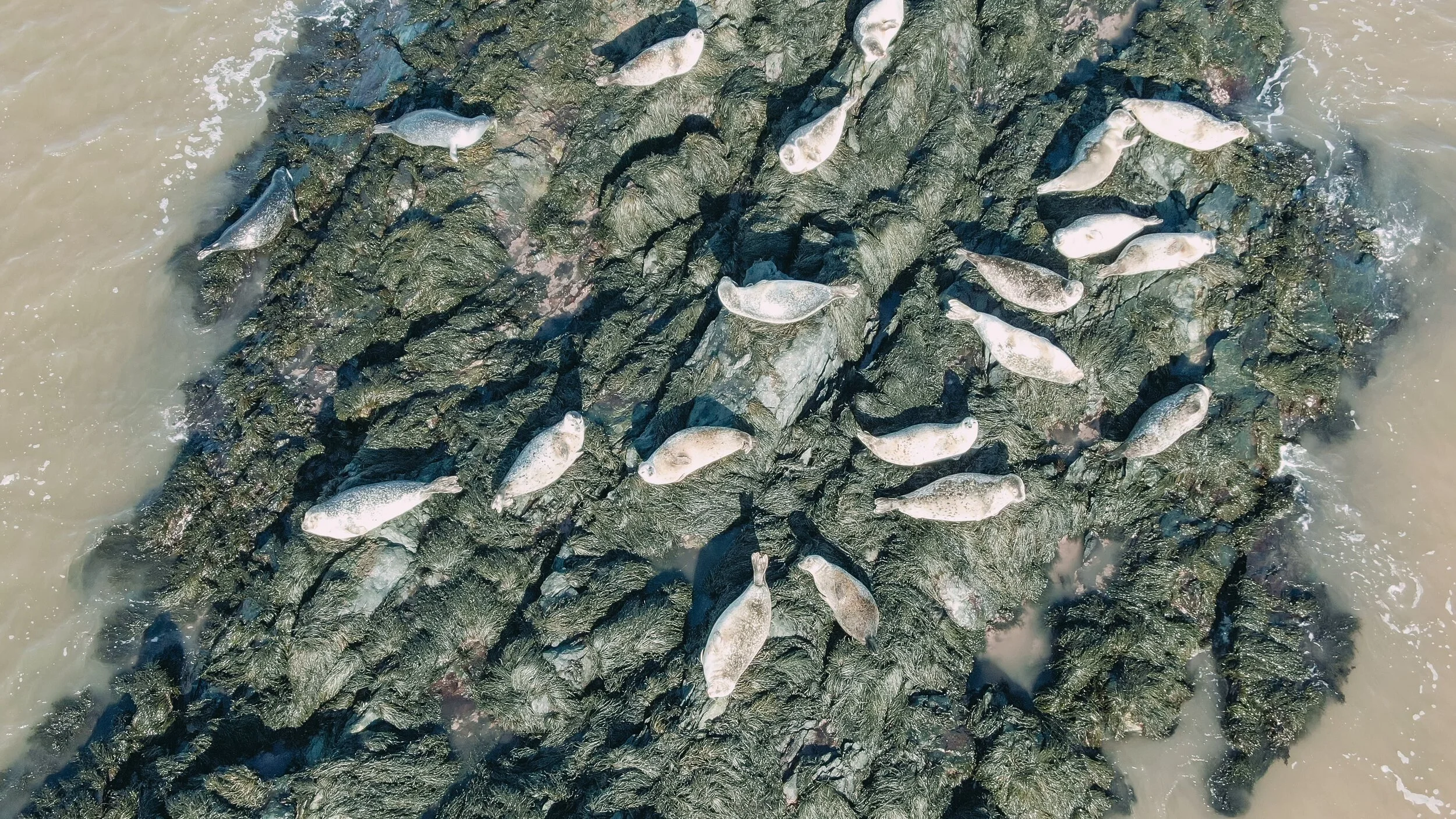
Drone footage of seals hauled out at low tide.
What is a pinniped?
The word “pinniped” means fin or flipper-footed and refers to marine mammals that have front and rear flippers. Animals that belong in this group includes seals, sea lions and walruses. Although they live in the ocean, they are also adapted to come on land for long periods of time. There are three families of pinnipeds: phocids (seals), otariids (sea lions) and odobenids (walruses). Out of the three pinniped families, only phocids are found in the Bay of Fundy.
Phocids
All true seals (earless) are members of the Phocidae family and can be identified by looking at the ears and flippers. Instead of external ear flaps earless seals have ear holes and small front flippers. Phocids move on land by flopping along on their bellies and when at sea they will move their flippers back and forth like a fish’s tail to propel themselves through the water. The Harbour seal, Phoca vitulina, has the broadest range of any pinniped species. Their habitat includes near-shore, coastal waters on both Canada’s Arctic and Atlantic coasts.
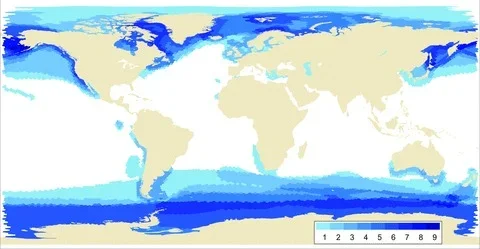
Global distribution of pinnipeds. Blue color intensity increases with the number of taxa represented in a given area (Source: Kovacs et al., 2012).
Haul out Site
Seals can often be seen out of the water on both rocky and sandy substrates on isolated rocks and islands, referred to as a haul-out site. A haul-out site is defined as a location (such as an intertidal ledge, mudbank, beach or ice flow) where a seal will come completely out of the water and lie quietly for a few hours. In areas like the Bay of Fundy, with high tidal influence, haul out sites are exposed as the tide goes out. It’s thought that seals will haul out to rest, for thermoregulation and to avoid predators. Most individuals will remain relatively stationary between 1-2 haul out sites and do not migrate.


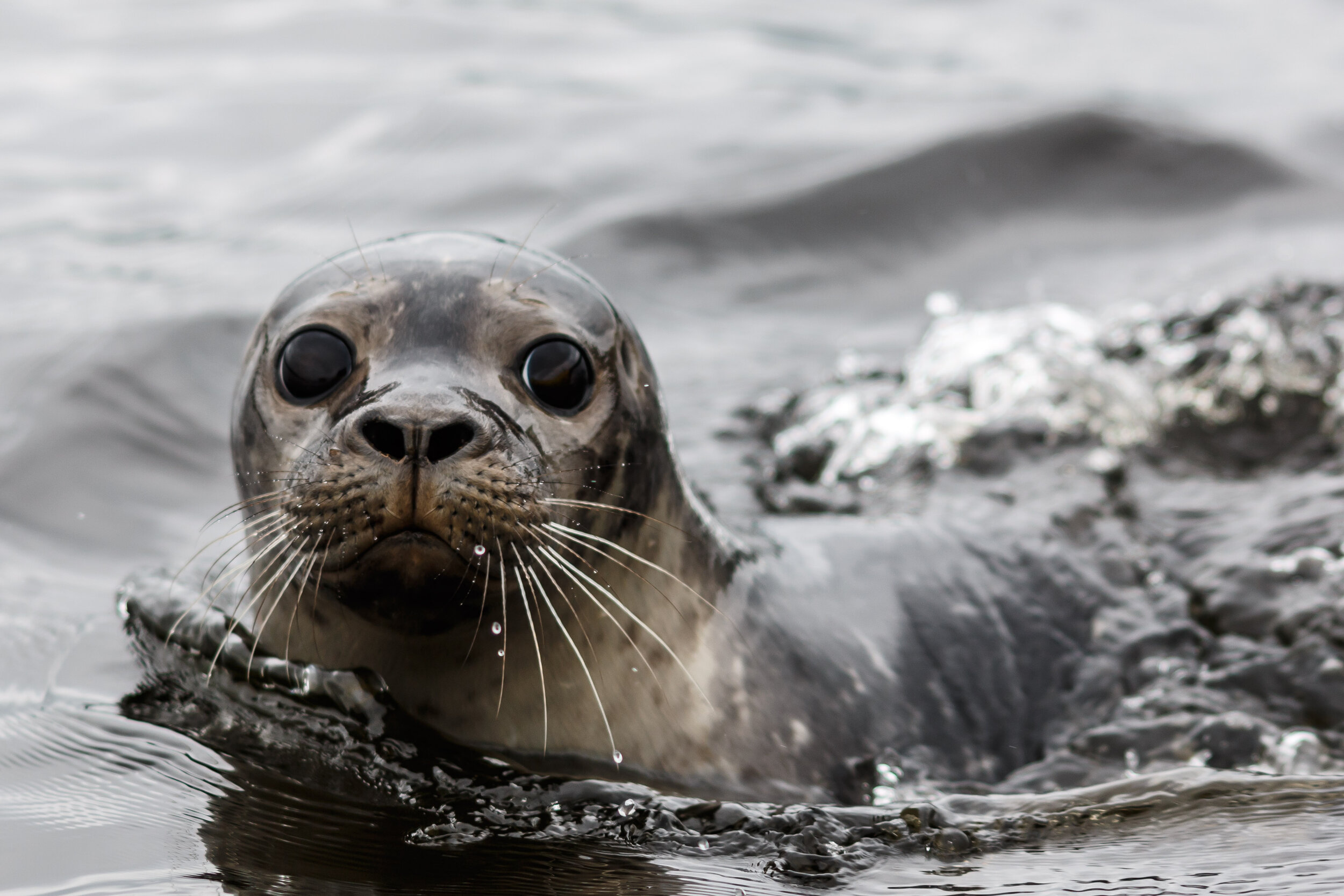
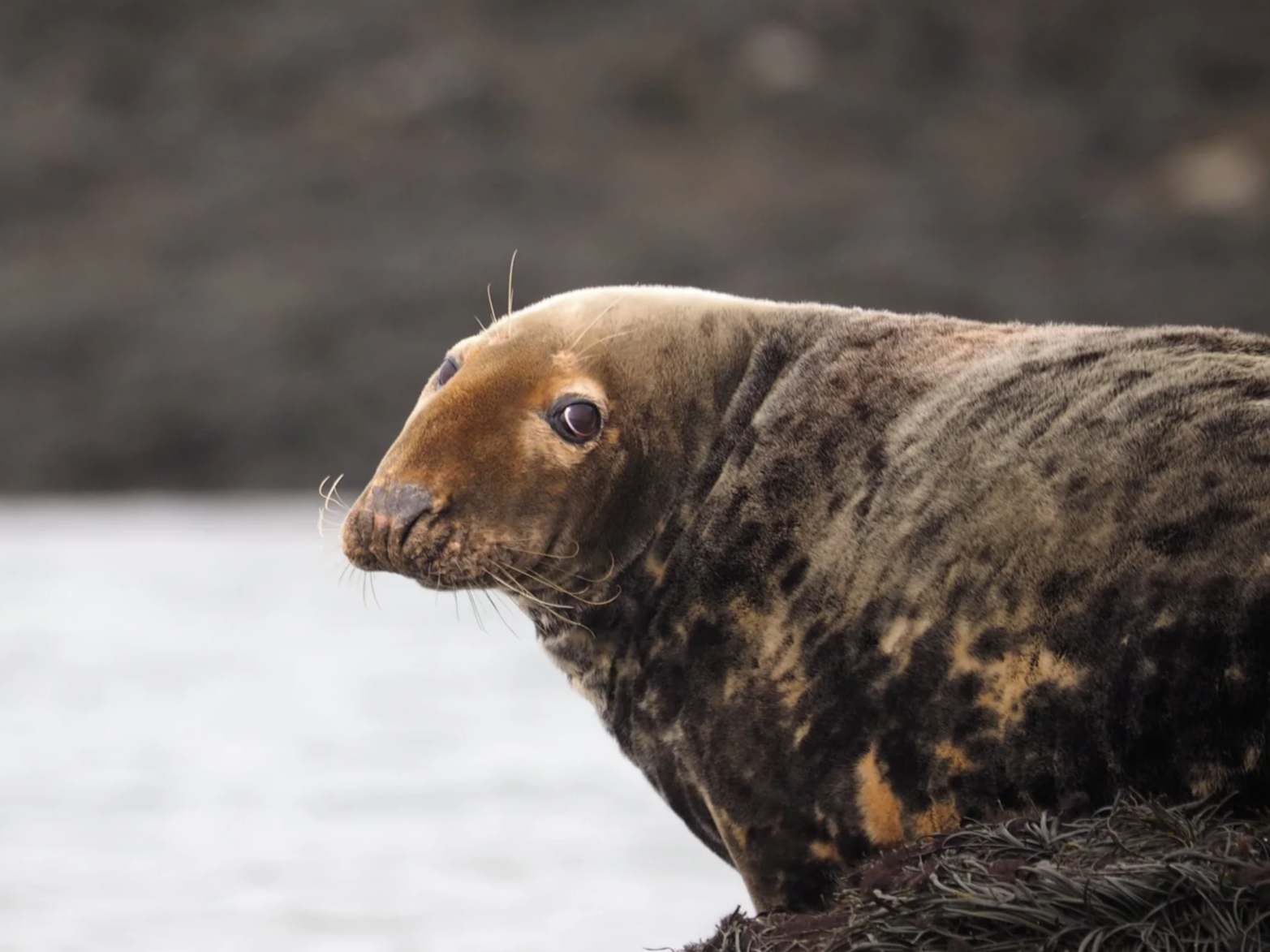
Facial structure differences between Harbour seal (left) and Grey Seal (right). Photos taken by Liane Thibodeau & ACAP Saint John
-
The colouration of Harbour Seals is extremely variable, from uniform brown or black to nearly yellowish-white with variations of dark and light irregular spots. A female Harbour Seal can weigh up to 70kg (150lbs) and males can up to 90kg (200lbs).
In general, Grey Seals are larger than Harbour Seals, with females weighing up to 230kg (500lbs) and males weighing up to 350kg (750lbs). Although their colouration is also quite variable, Grey Seals can be distinguished by their longer, broader nose and more parallel nostrils compared to the Harbour Seal’s more rounded prominent forehead, shorter nose and ‘V’ shaped nostrils.
-
A seal diet is very broad, feeding on various species of fish and invertebrates. Adult Harbour Seals can eat 3-5kg of food per day, while Grey Seals can eat 5-15kg of food each day and will fast during the mating/pupping seasons.
Through DNA analysis of seal scat, ACAP Saint John has discovered that seals in the Musquash Estuary MPA particularly like eating monkfish and rockling!
-
Female Harbour Seals give birth to seal pups in late May on a haul out site. Their pups begin to swim within hours of birth and will wean off their mom between 4-6 weeks of being born.
Grey seal pups are born from late December to early February with a white fluffy coat that they shed within their first month and will nurse for about 2-3 weeks before weaning.
-
The population of Harbour Seals in the Bay of Fundy/Southwest Nova Scotia is thought to be ~4,000 and increasing.
The Canadian Grey Seal population is estimated to be ~424,300 with the largest colony located on Sable Island, Nova Scotia.
-
Some threats to their population here in the Bay of Fundy include:
Hunted by fishermen (although protected from seal hunting in Atlantic Canada)
Mortality due to fishing gear (groundfish gillnets, herring weirs)
Human interactions such as motorized boats, kayaks, and canoes are a disturbance to haul-out sites
Contaminants such as heavy metal and plastic debris pose a potential threat
Sources
Kovacs, K. M., Aguilar, A., Aurioles, D., Burkanov, V., Campagna, C., Gales, N., Gelatt, T., Goldsworthy, S. D., Goodman, S. J., Hofmeyr, G. J. G., Härkönen, T., Lowry, L., Lydersen, C., Schipper, J., Sipilä, T., Southwell, C., Stuart, S., Thompson, D., & Trillmich, F. (2012). Global threats to pinnipeds. Marine Mammal Science, 28(2), 414–436. https://doi.org/10.1111/j.1748-7692.2011.00479.x